




Resistance training is any exercise that forces muscles to overcome resistance — this can be your own body weight, resistance bands, dumbbells, or gym machines. The goal is to make muscles stronger and more toned, not to bulk up. For beginners, 2–3 sessions per week, 30–40 minutes each, is enough to see changes after about 6–8 weeks.
How does resistance training differ from cardio?
Cardio burns calories while you exercise. Resistance training preserves and builds muscle mass — which is what determines how many calories your body burns at rest. That is why weight loss through cardio alone often leads to a lower weight while the body remains soft and lacks definition.
A less-mentioned benefit: resistance training increases bone density — vital for women because the risk of osteoporosis is higher in women than in men, especially after menopause.
4 forms of resistance training — which one to choose?
| Form | Initial Cost | Learning Curve | Best For | Limitations |
|---|---|---|---|---|
| Bodyweight | Zero | Easy | Absolute beginners, home workouts | Hard to increase load as you get stronger |
| Resistance bands | Low | Easy | Home workouts, travel-friendly | Resistance is not consistent throughout range of motion |
| Dumbbells, kettlebells | Medium | Medium | Progressive overload | Requires technique to avoid injury |
| Gym machines | Membership fee | Easy | Beginners worried about form | Fixed trajectory, less muscle stabilization |
For beginners, a reasonable roadmap is: the first 4 weeks using bodyweight to learn form → add resistance bands to increase load → switch to weights once stable. In those first four weeks, the squat is the foundational movement most worth your time to get right — details are in the article how to squat correctly for women.
Which resistance band level to choose?
Resistance bands are usually color-coded by light–medium–heavy tension, but color codes are not consistent across brands, so do not choose by color. The correct way to choose: select a level where you can perform 12–15 repetitions with perfect technique and the last 3 reps feel truly heavy. If you can do 20 reps easily, the band is too light.
It is best to buy a set of 3 levels rather than just one: leg and glute muscle groups are much stronger than shoulder and arm groups, so using the same level for both will result in incorrect loading.
Will resistance training make women bulky?
This is a fear that keeps many people away from the weight area. The answer: it is very difficult. Women have much lower testosterone levels than men, so muscle gain is a slow process and requires a deliberate calorie surplus over a long period. Resistance training 2–3 times a week while eating at a maintenance or slight deficit level will yield the opposite result: looking leaner at the same weight.
The feeling of "bulking up" in the first 2–3 weeks is usually water retention due to mild inflammation after exercise, not actual muscle growth. It goes away on its own once the body adjusts to the rhythm.

3-session weekly routine for beginners
Principle: each session should hit the upper body, lower body, and core. Rest at least 1 day between sessions.
- Lower body: squats 3 sets × 12 reps · glute bridges 3 × 15 · static lunges 3 × 10 per side.
- Upper body: knee push-ups 3 × 8 · resistance band rows 3 × 12 · overhead band press 3 × 12.
- Core: planks 3 sets, 20–60 seconds each depending on level · dead bugs 3 × 10 per side.
- Rest between sets: 60–90 seconds.
Proper plank technique is in the article how to plank correctly for women. If you want to add cardio, read 5 at-home cardio workouts. If your main goal is belly fat, see more on how to lose lower belly fat for women.
How to increase load correctly
Muscles only get stronger when they are challenged more than the previous time. Every 1–2 weeks, increase one of three things: reps, sets, or resistance level — only one thing at a time. Increasing all three simultaneously is the fastest way to get joint pain and quit training.
Realistic milestone: after 6–8 weeks of consistent training, most beginners feel significantly stronger and clothes fit better, even if the weight sometimes stays the same. That is a positive sign, not a sign of failure.
What to wear for resistance training
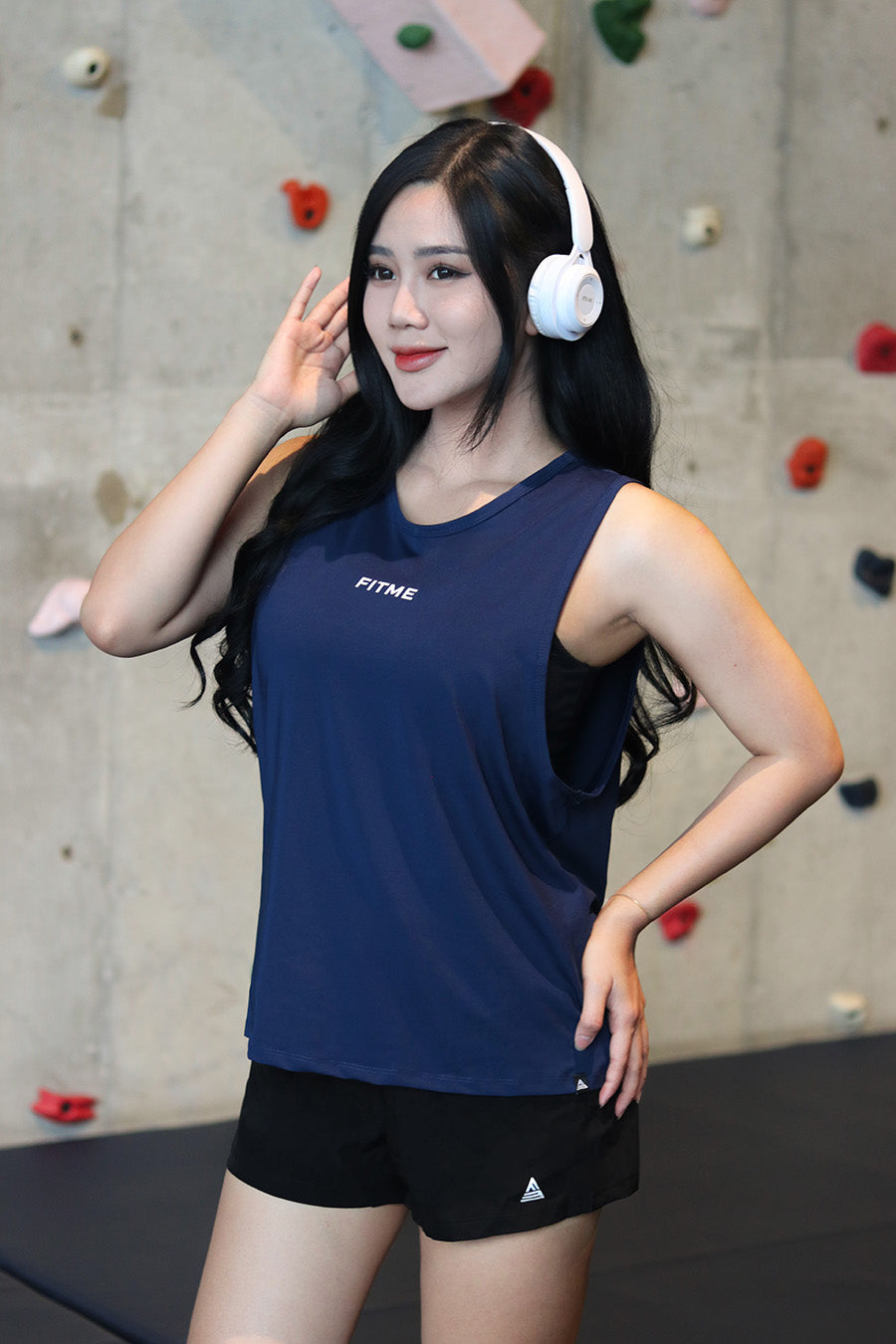
Unlike cardio, resistance training involves many deep squats and bends, so two things need to be right: high-waisted leggings thick enough to be squat-proof, and mid-impact sports bras that offer support without constricting your chest when breathing deeply. Criteria for choosing pants are in the article what is squat-proof. See the full range of Fitme Women's Gym & Yoga Apparel.
Frequently Asked Questions
What is resistance training?
It is any exercise that forces muscles to overcome resistance, which can be body weight, resistance bands, dumbbells, or machines. The goal is to make muscles stronger and more toned while increasing bone density.
Will resistance training make women bulky?
Very difficult. Women have much lower testosterone levels than men, so muscle growth is slow and requires a deliberate calorie surplus over a long period. Training 2–3 sessions per week while eating at maintenance will lead to a leaner look at the same weight.
How many sessions a week should a beginner train?
2 to 3 sessions per week, 30 to 40 minutes each, with at least 1 rest day between sessions. Each session should hit the upper body, lower body, and core.
How to choose the right resistance band level?
Do not choose by color because color codes are not consistent across brands. Choose a level where you can perform 12 to 15 reps with perfect technique and the last 3 reps are truly heavy. Buy a set of 3 levels because the leg muscle group is much stronger than the arm and shoulder groups.
How long does it take to see results?
About 6 to 8 weeks of consistent training. The first signs are usually feeling stronger and clothes fitting better, even if weight stays the same because muscle is denser than fat at the same volume.



Leave a comment
This site is protected by hCaptcha and the hCaptcha Privacy Policy and Terms of Service apply.